Mostrando entradas con la etiqueta moral. Mostrar todas las entradas

viernes, 29 de febrero de 2008

Economía Moral: Cambios estructurales inesperados e inverosímiles

Julio Boltvinik jbolt@colmex.mx


Crecimiento chino en el medio rural y recesión en el semiurbano
Un paradigma que hasta ahora no había sido puesto en duda es la existencia de una asociación muy fuerte entre tamaño de la localidad y nivel de vida de sus habitantes; que las peores condiciones de vida (ingresos y satisfacción de necesidades básicas) se encuentran en las localidades de menor tamaño y que a medida que pasamos a mayores tamaños éstas van mejorando. Los contrastes urbano-rurales han sido destacados desde hace mucho, tanto desde la perspectiva de los índices de marginación como de los contrastes en la satisfacción de las necesidades específicas (Véase la Serie Necesidades Esenciales en México, Coplamar-Siglo XXI, 1982-1983 (6 volúmenes). Con un espectro de tamaños de localidades más detallado, encontré que en 1989 (a partir de la base de datos de la Encuesta Nacional de Ingresos y Gastos de los Hogares, ENIGH, de 1989 ajustada a cuentas nacionales), la proporción de población en pobreza1 desciende a medida que pasa uno de localidades menores a mayores. Igualmente Araceli Damián y yo encontramos, a partir de la ENIGH1996 sin ajuste a cuentas nacionales, una fuerte asociación entre tamaños de localidad, todavía más desglosados, y la menor incidencia de la indigencia (la más extrema de las pobrezas)2, cuyos valores fueron: rural: 78.1 por ciento; 2 mil 500 a 15 mil (semiurbanos): 57.4 por ciento; 15 mil a 100 mil: 43.1 por ciento. Toda la evidencia, vieja y nueva, sostiene que este paradigma se basa en realidades estructurales que cambian muy poco.

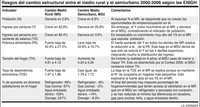
Sin embargo, al comparar la evolución del ingreso y las condiciones de vida según las ENIGH de 2000 y 2006, enfrentamos un fenómeno inesperado. Al desagregar en dos grupos las localidades de menos de 15 mil habitantes (límite urbano-rural oficial), el de menos de 2 mil 500 (en adelante medio rural, MR) y el de 2 mil 500 a 15 mil (en adelante medio semiurbano, MSU), se encuentra una evolución 2000-2006 que contradice dicho paradigma y que tiende a eliminar las diferencias entre ambos, y en ocasiones revertirlas, provocando un cambio estructural inesperado e inverosímil, cuyos rasgos se analizan a continuación (véase cuadro):

Evolución opuesta de la población. Como se apreciará, esta evolución se mueve en sentido opuesto a las demás. Mientras la población rural decrece en 2.8 por ciento, la semiurbana crece en 6.9%. El crecimiento demográfico suele ser resultado del crecimiento económico y el descenso de la población de la crisis (la gente se traslada adonde hay empleos y huye de donde no hay), por lo cual estos datos (si fueran los únicos que tuviéramos) nos harían pensar que habría habido crecimiento económico y mejoría en las condiciones de vida en el MSU y estancamiento o empeoramiento en el MR. Pero según las ENIGH fue exactamente al revés. Veamos.

Evolución radicalmente opuesta de los ingresos. El ingreso por persona en el MR crece a un ritmo semejante al de la economía China: 62.6 por ciento en el sexenio (un incremento anual simple promedio mayor a 10 por ciento). En contraste, el ingreso del MSU decrece en 20.9 por ciento. Se asocia así el crecimiento del ingreso al despoblamiento y el descenso del ingreso al crecimiento demográfico.

Evolución dispar de la pobreza alimentaria. En 2000, la incidencia de la ‘pobreza alimentaria’ del método oficial, era de 52.9 por ciento en el MR y de 22.8 por ciento en el MSU. Más del doble en las primeras que en las segundas. Pero el milagro chino del crecimiento del ingreso rural redujo esta pobreza a sólo 27.4 por ciento (casi a la mitad: el dato de 2006 es sólo 51.8 por ciento del de 2000), mientras la pobreza semiurbana bajó sólo tres puntos y terminó en 19.7 por ciento. Se redujo así la distancia en la incidencia de la pobreza entre ambos medios de 30 puntos a sólo 8. La pequeña baja de la pobreza semiurbana, a pesar de la reducción del ingreso promedio por persona, se explica porque ésta sólo ocurre en los cuatro deciles superiores, mientras hay aumentos en los demás. Es decir, se produjo una mejoría sustancial de la distribución del ingreso en este medio, lo que no ocurrió en el rural, donde el ingreso de todos los deciles aumentó de manera similar.

Ordenación invertida en el tamaño del hogar. Una explicación parcial de los movimientos opuestos en el ingreso por persona en ambos medios, es la evolución contrapuesta en el tamaño del hogar (número de integrantes), que disminuye notablemente en el MR (de 4.61 a 4.13) y aumenta en el MSU (de 4.24 a 4.34), produciendo con ello la inversión en la ordenación de tamaños entre ambos medios, siendo en 2006 mayores los hogares semiurbanos que los rurales, cuando eran mucho más pequeños en 2000. Un cambio estructural inesperado e inverosímil, y falso porque según el Conteo de Población de 2005, los hogares semiurbanos son más pequeños que los rurales.

Se invierte el orden en la tasa de dependencia económica (TDE). En el 2000 la TDE era de 1.97 en el MR, es decir, había 1.97 dependientes por cada ocupado, contra 1.78 en el MSU, pero al bajar mucho esta relación en el primero (a 1.66) y mantenerse casi igual en el segundo (1.72), se invirtió el orden: ahora es más alta la TDE en el MSU. Lo ocurrido en el MR es un auténtico milagro: los hogares se hacen más pequeños, pero el número de ocupados permanece igual y sólo disminuyen los dependientes. Esto explica que el ingreso por persona derivado de salarios crezca, en el MR, en 83.4 por ciento mientras en el MSU decrecen en 3.6 por ciento.

Inversión o reducción drástica de brecha en acceso a satisfactores del hogar. Como se aprecia en el cuadro, el MR ha alcanzado condiciones de vida casi iguales y, en dos casos mejores, que el MSU.

Con esto se completan los cambios estructurales sorprendentes, pero desgraciadamente inverosímiles y, en algunos casos, ya sabemos que falsos.

1Véase el capítulo, de mi autoría, “Incidencia e intensidad de la pobreza en México”, en Julio Boltvinik y Enrique Hernández Laos, Pobreza y distribución del ingreso en México, Siglo XXI, 1999).

2 “La pobreza en México en 1996”, elaborado para el Centro de Promoción Social, AC, en 1999.

jueves, 17 de enero de 2008

Which of the following people would you say is the most admirable: Mother Teresa, Bill Gates or Norman Borlaug?

The Moral Instinct


Illustration by Adrian Tomine


Article Tools Sponsored By
Published: January 13, 2008


Which of the following people would you say is the most admirable: Mother Teresa, Bill Gates or Norman Borlaug? And which do you think is the least admirable? For most people, it's an easy question. Mother Teresa, famous for ministering to the poor in Calcutta, has been beatified by the Vatican, awarded the Nobel Peace Prize and ranked in an American poll as the most admired person of the 20th century. Bill Gates, infamous for giving us the Microsoft dancing paper clip and the blue screen of death, has been decapitated in effigy in "I Hate Gates" Web sites and hit with a pie in the face. As for Norman Borlaug . . . who the heck is Norman Borlaug?
Yet a deeper look might lead you to rethink your answers. Borlaug, father of the "Green Revolution" that used agricultural science to reduce world hunger, has been credited with saving a billion lives, more than anyone else in history. Gates, in deciding what to do with his fortune, crunched the numbers and determined that he could alleviate the most misery by fighting everyday scourges in the developing world like malaria, diarrhea and parasites. Mother Teresa, for her part, extolled the virtue of suffering and ran her well-financed missions accordingly: their sick patrons were offered plenty of prayer but harsh conditions, few analgesics and dangerously primitive medical care.
It's not hard to see why the moral reputations of this trio should be so out of line with the good they have done. Mother Teresa was the very embodiment of saintliness: white-clad, sad-eyed, ascetic and often photographed with the wretched of the earth. Gates is a nerd's nerd and the world's richest man, as likely to enter heaven as the proverbial camel squeezing through the needle's eye. And Borlaug, now 93, is an agronomist who has spent his life in labs and nonprofits, seldom walking onto the media stage, and hence into our consciousness, at all.
I doubt these examples will persuade anyone to favor Bill Gates over Mother Teresa for sainthood. But they show that our heads can be turned by an aura of sanctity, distracting us from a more objective reckoning of the actions that make people suffer or flourish. It seems we may all be vulnerable to moral illusions the ethical equivalent of the bending lines that trick the eye on cereal boxes and in psychology textbooks. Illusions are a favorite tool of perception scientists for exposing the workings of the five senses, and of philosophers for shaking people out of the naïve belief that our minds give us a transparent window onto the world (since if our eyes can be fooled by an illusion, why should we trust them at other times?). Today, a new field is using illusions to unmask a sixth sense, the moral sense. Moral intuitions are being drawn out of people in the lab, on Web sites and in brain scanners, and are being explained with tools from game theory, neuroscience and evolutionary biology.
"Two things fill the mind with ever new and increasing admiration and awe, the oftener and more steadily we reflect on them," wrote Immanuel Kant, "the starry heavens above and the moral law within." These days, the moral law within is being viewed with increasing awe, if not always admiration. The human moral sense turns out to be an organ of considerable complexity, with quirks that reflect its evolutionary history and its neurobiological foundations.
These quirks are bound to have implications for the human predicament. Morality is not just any old topic in psychology but close to our conception of the meaning of life. Moral goodness is what gives each of us the sense that we are worthy human beings. We seek it in our friends and mates, nurture it in our children, advance it in our politics and justify it with our religions. A disrespect for morality is blamed for everyday sins and history's worst atrocities. To carry this weight, the concept of morality would have to be bigger than any of us and outside all of us.
So dissecting moral intuitions is no small matter. If morality is a mere trick of the brain, some may fear, our very grounds for being moral could be eroded. Yet as we shall see, the science of the moral sense can instead be seen as a way to strengthen those grounds, by clarifying what morality is and how it should steer our actions.
The Moralization Switch
The starting point for appreciating that there is a distinctive part of our psychology for morality is seeing how moral judgments differ from other kinds of opinions we have on how people ought to behave. Moralization is a psychological state that can be turned on and off like a switch, and when it is on, a distinctive mind-set commandeers our thinking. This is the mind-set that makes us deem actions immoral ("killing is wrong"), rather than merely disagreeable ("I hate brussels sprouts"), unfashionable ("bell-bottoms are out") or imprudent ("don't scratch mosquito bites").
The first hallmark of moralization is that the rules it invokes are felt to be universal. Prohibitions of rape and murder, for example, are felt not to be matters of local custom but to be universally and objectively warranted. One can easily say, "I don't like brussels sprouts, but I don't care if you eat them," but no one would say, "I don't like killing, but I don't care if you murder someone."
The other hallmark is that people feel that those who commit immoral acts deserve to be punished. Not only is it allowable to inflict pain on a person who has broken a moral rule; it is wrong not to, to "let them get away with it." People are thus untroubled in inviting divine retribution or the power of the state to harm other people they deem immoral. Bertrand Russell wrote, "The infliction of cruelty with a good conscience is a delight to moralists — that is why they invented hell."
Steven Pinker is the Johnstone Family Professor of Psychology at Harvard University and the author of "The Language Instinct" and "The Stuff of Thought: Language as a Window Into Human Nature."