¿Google viola la intimidad?
El último programa de la compañía, el Street View, permite ver imágenes en 360º de distintos barrios y ciudades. Hace unos días fue lanzado y ya generó polémica
El programa funciona de manera similar al Google Earth, que contiene imágenes satelitales de todo el mundo. Street View es más preciso y permite ver imágenes de ciudades, haciendo posible conocer barrios antes de visitarlos, por ejemplo.
Sin embargo, las fotografías incluyen personas, lo cual ha generado que varias de ellas sintieran que se estaba violando su privacidad.
Por ejemplo, se han registrado los casos de una mujer tomando sol en bikini o de un hombre saliendo de un local nudista.
El programa por ahora sólo permite visualizar ciudades de los Estados Unidos y se espera por una respuesta al reclamo de los damnificados.
http://www.infobae.com/contenidos/368298-100884-0-Google-viola-la-intimidad
Mostrando entradas con la etiqueta eua. Mostrar todas las entradas
Mostrando entradas con la etiqueta eua. Mostrar todas las entradas
domingo, 9 de marzo de 2008


jueves, 24 de enero de 2008
Nuevo paciente en la crisis: LOS BONOS!
Next on the Worry List: Shaky Insurers of Bonds
Even as stocks ended five days of losses with a surprising recovery on Wednesday, officials began moving to defuse another potential time bomb in the markets: the weakened condition of two large insurance companies that have guaranteed buyers against losses on more than $1 trillion of bonds.
Regulators fear a possible chain of events in which the troubled bond insurers, MBIA and Ambac, might be unable to keep their promise to pay investors if borrowers default on their debt.
That could leave the buyers of the bonds — including many banks and pension funds — on the hook for untold billions of dollars in losses, shaking confidence in the financial system.
To avoid a possible crisis, insurance regulators met with representatives of about a dozen banks on Wednesday to discuss ways to shore up the insurers by injecting fresh capital, much as Wall Street firms have turned to outside investors recently after suffering steep losses related to subprime mortgages.
While it is unclear what steps, if any, the banks and regulators may ultimately take, the talks focused on raising as much as $15 billion for the companies, according to several people briefed on the discussion who asked not to be identified because of the sensitive nature of the discussions.
The notion that the failure of even one big bond insurer might touch off a chain reaction of losses across the financial world has unnerved Wall Street and Washington. It was a factor in the Federal Reserve's decision on Tuesday to calm investors by reducing interest rates by three-quarters of a point, to 3.5 percent.
News of Wednesday's meeting helped rally stocks, which had been down as much as 3 percent but ended up about 2 percent. Shares of MBIA jumped by nearly a third and Ambac jumped 72 percent, although they both remain far below their levels before the extent of the mortgage debacle became known.
Traditionally, bond insurance has been a low-risk business. State and municipal bonds rarely defaulted, so the insurers paid out few claims for such debt. But in recent years the bond insurers increasingly have guaranteed debt related to subprime mortgages, a business that they thought was safe but has turned out to be risky.
Now, as many subprime borrowers are defaulting, insurers could be obligated to cover some of the losses on securities backed by these loans.
Eric R. Dinallo, the New York insurance superintendent who regulates MBIA, called Wall Street executives on Tuesday to set up the meeting at his office in Lower Manhattan. He led the session on Wednesday and suggested that the group move in as little as 48 hours to get a deal done ahead of any downgrading of the bond guarantors by credit ratings firms.
According to two people, Mr. Dinallo said he would talk with the bankers one on one and reconvene the group — which included executives from Citigroup, Goldman Sachs and Merrill Lynch — on Thursday or Friday. Neither federal officials nor executives of the two insurers attended the meeting.
"Regulators are furiously trying to come up with a plan," said Rob Haines, an analyst at CreditSights, a research firm, who was not at the meeting.
Mr. Dinallo could face resistance from banks that do not have significant exposure to the guarantors and thus have less incentive to put up money. It is also unclear how executives and shareholders of the companies would react to the plan and the prospect of ceding control.
Sean Dilweg, the commissioner of insurance in Wisconsin, which regulates Ambac, sat in on the meeting but said he would be working with Ambac directly. Mr. Dilweg said he met separately on Tuesday with executives at Ambac, which is based in New York but chartered in Wisconsin.
"Eric is looking at the overall issue, but I am pretty confident that we will work through Ambac's specific issues," Mr. Dilweg said in a telephone interview. "They are a stable and well-capitalized company but they have some choices to make."
Other options open to the banks include providing lines of credit and other backup financing to the guarantors. A chief goal of any rescue would be to help the companies regain or keep triple-A credit ratings, which are seen as vital to their business.
Late last year, Mr. Dinallo encouraged Berkshire Hathaway, the company controlled by Warren E. Buffett, to enter the bond insurance business. At the time, Mr. Buffett said he did not want to invest in existing guarantors because of their financial problems, and he started his own firm instead.
1 2 Next Page »
miércoles, 23 de enero de 2008
Déficit gringo
Plan reactivador de EUA en marcha.
(Reuters) El presidente George W. Bush estimó ayer que podría alcanzarse pronto un acuerdo con el Congreso estadounidense sobre un paquete de estímulo fiscal y dijo que era necesario lidiar con la "incertidumbre" que rodea al panorama económico.
"Confío en que podamos aprobar un acuerdo de manera relativamente rápida", dijo Bush a la prensa en un evento.
"Todos nosotros queremos tener algo listo (...) que sea temporario y efectivo y todos queremos que sea lo más rápido posible", agregó.
Pedido de Paulson
Por su parte el secretario del Tesoro, Henry Paulson, indicó que confía en que las economías de EE.UU. y el mundo sean resistentes, pero recibió con beneplácito un recorte en las tasas de interés hecho por la FED.
Paulson reconoció una desaceleración "material" en la economía estadounidense durante las últimas semanas, pero insistió en que pese al desplome global en los precios de las acciones, la economía del mundo tenía una "resistencia esencial" que le ayudará a capear la tormenta.
"Necesitamos hacer algo ahora, ya que los riesgos a corto plazo son claramente a la baja y los beneficios potenciales de una acción rápida para apoyar nuestra economía se han vuelto claros", dijo Paulson. Agregó que el tiempo es esencial y el presidente Bush está preparado para trabajar con ambos partidos.
Déficit
Al margen del plan reactivador, Bush va rumbo a dejar al gobierno federal en una situación financiera peor que la que él heredó, lo que le dificultará a quien lo reemplace a cumplir las promesas hechas en la campaña electoral de este año.
Bush podría concluir sus ocho años en el cargo con un déficit presupuestario superior al pronosticado y cercano al récord de US$ 413,000 millones alcanzado en 2004.

Tomado del Diario Gestión 23.01.08
George Colony: Recesión es sólo de servicios financieros, las compañías tecnológicas crecerán y acabarán con la crisis para junio.
US rate cut stuns Davos leaders | |||||

The US Federal Reserve's unexpected rate cut has stunned the movers and shakers assembling in Davos for the World Economic Forum. It was the hottest topic here during the first briefings and welcome receptions on Tuesday evening. Many had heard the news while they were stuck in trains, buses or automobiles, slowly winding their way up to this snow-covered Swiss mountain valley. As executives and economists debated the implications, many dared using the dreaded "r" word - recession. But this was not a wholly pessimistic crowd. "There are a lot of positive voices here," said Kevin Kelly, chief executive of global headhunting firm Heidrick & Struggles. He believes the Fed's action was "long overdue". "They had to act now, they could not have waited until their next scheduled rate meeting," said Mr Kelly. But would there be a recession? "In some ways it's already happened," he said. "The question is will it be long and shallow or short and deep?" 'The skies have darkened' Sam DiPiazza, global chief executive of PricewaterhouseCoopers (PwC), believes that a recession can be avoided.
The United States was going through a downturn, but would not suffer a recession, predicted Mr DiPiazza - at least not in the technical sense of the word, where a recession is defined as two consecutive quarters during which the economy shrinks. "It's quite hard seeing the US [in that situation]," he said, but admitted that the past 30 days had "given us some reason to pause... the skies have darkened". "I think the Fed is simply reacting to a very loud voice in the markets, and it is using the one tool it has - interest rates," said Mr DiPiazza. But while the short-term outlook might be bleak - two-thirds of US bosses are dubious about their company's prospects during the next 12 months - over a three year horizon corporate confidence was back to normal, said Mr DiPiazza. Robust demand in developing markets had provided the global economy with a "cushion", he said. "The question is how long will this cushion last?" Recovery in June? George Colony, chief executive of technology research firm Forrester, is convinced the recession has already arrived.
"If you look at the [US small company index] Russell 2000, it's off its peak by 20%, that's a clear indicator of a recession," he argued. But this recession was sector specific, hitting mainly the financial services industry, said Mr Colony. Technology companies, in contrast, were still growing - albeit at a steady rate. And Mr Colony believes the recession will be short, with a recovery as early as this summer. Strong growth in Asia Jeff Clarke, chief executive and president of global travel firm Travelport, called the rate cut a "quite decisive move", which "clearly has stemmed the fall" on stock markets around the world. "Lowering the cost of money is a good thing for corporations," said Mr Clarke. He believes that companies like his will be largely unaffected by the economic downturn. Travelport owns the travel reservation networks Galileo and Worldspan, and the consumer travel website Orbitz. His firm is paid per transaction, and during an economic downturn airlines and hotel chains will cut prices to keep filling seats and beds. Furthermore, while his company already sees that business in the United States and Western Europe is weakening, demand is growing strongly in Asia and the Middle East. "Very rarely does the whole world go into a recession," said Mr Clarke. Mr Clarke's observation is backed up by a global survey of chief executives. Compiled by PwC during the last three months of 2007, the poll suggests a "tale of two worlds", with business confidence slumping in developed economies like the United States and many European countries. Across the world, bosses say that a global recession is currently the biggest threat for their companies. But according to the survey, chief executives in countries like Russia, India and China are still very confident that their companies are set for growth. "I don't see the emerging economies talking themselves into a recession," says Mr Clarke. | |||||


 Very rarely does the whole world go into a recession

Soros sonríe del futuro: Veo crisis en EUA que favorecerán a China
Soros says US recession is likely | ||
In an interview with BBC News, Mr Soros said he supported the US Federal Reserve's surprise interest rate cut, which bolstered global stock indexes. "You do have to rescue markets otherwise you would go into a depression, as you did in the 1930s." He also said that the current market turmoil is a sign of global influence shifting to the developing world. 'Shift of power' "I'm not looking for a worldwide recession," he said. "I'm looking for a significant shift of power and influence away from the US in particular and a shift in favour of the developing world, particularly China." He added that authorities have trusted markets too much over the past 20 years. "The authorities came to rely on the markets to right themselves," he said. "But they ought to have known better because they have in the past come to the rescue." Mr Soros was the man reported to have made $1bn profit in September 1992, betting correctly that the British currency would have to be devalued and leave the European Exchange Rate Mechanism. | ||

Desde Davos: Existen burbujas inmobiliarias en Reino Unido y España,Crecimiento de empleo se cae en China, Precios de alimentos en África suben
Warning about US economic slump | |||||
The US mortgage crisis will spread to consumer and company loans, and push up defaults sharply, warned New York University economist Nouriel Roubini. A year ago, Mr Roubini had been one of the few economists to predict correctly a slump in the US housing market and subsequent crunch in credit markets. China and Europe will be hit, though India less so, the panel forecast.
Discussion about global economic turmoil is the hottest topic at this year's World Economic Forum, and this session was packed, with many participants turned away at the doors of the large conference room. 'Severe recession' After five years of strong global economic growth, it was now only a question how hard the landing of the US economy would be, said Mr Roubini, chairman of Roubini Global Economics.
He predicted a "severe recession" that could last for a whole 12 months. The US Federal Reserve would probably keep cutting rates, and that in turn might "make the recession a bit more shallow", but it would not stop the downturn. Mr Roubini was backed up by Stephen Roach, chairman of Morgan Stanley Asia, and a well-known "bear" or economic pessimist. He said both the Federal Reserve and the US government were trying to solve the current crisis by "reaching back into the same playbook that created the mess in the first place". Instead of tackling asset bubbles like inflated housing and stock markets head-on, they waited until the bubble had burst and then cleaned up afterwards. "That's a dangerous way of running the economy," said Mr Roach. The global fallout All panellists agreed that there would be no global recession. But there is an old economic saying: "When the US sneezes, the world catches a cold," and the panellists were divided about whether it still holds true. Mr Roubini was the most pessimistic. "This time round the US suffers a protracted pneumonia, and we can only guess what happens in the rest of the world." He predicted a bursting of housing bubbles in the UK, Ireland, and Spain. In Eastern Europe, meanwhile, many people had taken out mortgages denominated in euros, not their own country's currency. If those currencies started falling, "many homeowners will go belly-up," said Mr Roubini. Mr Roach said Europe's economy was simply not dynamic enough to get "a dispensation from the global economic slowdown". The region would be "lucky when it gets 2-3% [annual] growth". Ferenc Gyurcsany, prime minister of Hungary, disagreed. He EU growth rates would be hit, but not by much more than 0.8%. China and India to the rescue? But what about the emerging giants of the world economy, China and India? A popular topic of debate here at the World Economic Forum is whether the fast-growing Asian economies are now "decoupled" from the US Economy. Not so, argued Yu Yongding, director of the Institute of World Economics and Politics at the Chinese Academy of Social Sciences. China's economy was growing rapidly, he said, but that was because every year it needed to create 24 million jobs just to keep up - and last year it had reached only the 10 million mark. China's reliance on "external demand is enormous," he said. India's commerce minister Kamal Nath was more optimistic. East Asia, he said, was not as dependent on the US economy anymore, not least because South-South trade was soaring. India's economy itself, he said, was much more driven by domestic demand than foreign investment. Who will buy? Morgan Stanley's Stephen Roach, however, begged to differ. He was very optimistic about Indian and Chinese consumers, he said, but only in the long-term. US consumers bought goods and services worth $9.5 trillion every year, a demand that was currently running at 5% above historical levels. The Chinese consumer market, in contrast, amounted to just $1 trillion, and India's to a mere $500bn. That was not large enough to take up the slack left by the US downturn. Africa worries about food And there were worries that Africa would be hit badly by the global economic turmoil. The reforms and better economic governance of the past decade had been rewarded with strong growth during the past few years, said Ngozi Okonjo-Iweala, a managing director of the World Bank. But she said there was uncertainty whether Africa's economies were robust enough to cope with a sharp downturn, especially if it resulted in China cutting back on importing raw materials. Her biggest worry, though, was the recent rise in food prices. Yes, it would help farmers in Africa and other developing nations. But there were even more people in urban areas who would find it difficult to cope. Mr Nath added that there were 25 million people in India who for the first time were able to afford not one but two meals a day. How would they be affected by a doubling of the price of wheat and other commodities? With the trend for biofuels driving up demand, the panellists wondered whether the market could provide an answer. Since the "green revolution" of the 1970s, agricultural productivity has been at a standstill in recent years, and as Stephen Roach pointed out, demand for food was "not optional". Next year, predicted Ms Okonjo-Iweala, the Davos participants would hear much more about the devastating impact of the rising cost of food. | |||||


http://news.bbc.co.uk/1/hi/business/7204368.stm
martes, 4 de diciembre de 2007
Aprueban APC USA-Perú
Con 77 votos a favor, 18 en contra, y 5 abstenciones se aprobó en el senado estadounidense el Tratado de Libre Comercio (Acuerdo de Promoción Comercial -APC) entre Perú y EUA.

Reservamoral.org(USA).- Con 77 votos a favor se aprobó el TLC con EUA. Cero aranceles, movilidad gradual de servicios profesionales y productos electrónicos más baratos será lo que poco a poco tendrá al Perú en los próximos años. El proceso de implementación se espera que dure seis meses cuanto menos, por lo que Reservamoral.org espera que en el inicio del segundo trimestre de 2008 el pais andino tenga Riesgo País menor (o Grado de inversión, lo que venga primero).

El comercio entre Perú y EUA ya está liberado hoy en día (en cuotas, y al 98% en muchos sectores) gracias al Tratado preferencial que tenemos por ser un país que lucha contra las drogas (ATPDEA). Lo que brinda el TLC aprobado es posibilidad de que estos beneficios sean eternos y con ello se faciliten las inversiones de largo plazo extranjeras (Perú es una economía liberal con dependencia prospectiva de la IED) y peruanas.
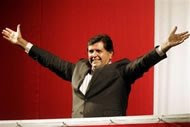
Este Tratado fue recibido con beneplácito en Lima. El presidente Alan García, quien hace unos años se opuso a que Alejandro Toledo lleve a cabo el TLC (amenazando con retirar la firma del Tratado en caso salga electo), celebró el tratado y asume el compromiso de facilitar su implementación. En un mensaje a la nación felicitó y celebró por el Perú, hecho a pocos minutos de confirmada la noticia, reacción distinta a la que tuvo después del terremoto del sur peruano, ocasión en la que sus declaraciones llegaron horas después.
El Congreso peruano debe en los próximos días iniciar la asimilición del Tratado en materia legal, tributaria y de migraciones. Por su parte el Ministro de la Producción, insiste en que este trabajo no estará completado hasta que se reduzcan los sobrecostos laborales (con el término denomina a los derechos de salud, seguridad y pensión).
Reservamoral.org(USA).- Con 77 votos a favor se aprobó el TLC con EUA. Cero aranceles, movilidad gradual de servicios profesionales y productos electrónicos más baratos será lo que poco a poco tendrá al Perú en los próximos años. El proceso de implementación se espera que dure seis meses cuanto menos, por lo que Reservamoral.org espera que en el inicio del segundo trimestre de 2008 el pais andino tenga Riesgo País menor (o Grado de inversión, lo que venga primero).
El comercio entre Perú y EUA ya está liberado hoy en día (en cuotas, y al 98% en muchos sectores) gracias al Tratado preferencial que tenemos por ser un país que lucha contra las drogas (ATPDEA). Lo que brinda el TLC aprobado es posibilidad de que estos beneficios sean eternos y con ello se faciliten las inversiones de largo plazo extranjeras (Perú es una economía liberal con dependencia prospectiva de la IED) y peruanas.
Este Tratado fue recibido con beneplácito en Lima. El presidente Alan García, quien hace unos años se opuso a que Alejandro Toledo lleve a cabo el TLC (amenazando con retirar la firma del Tratado en caso salga electo), celebró el tratado y asume el compromiso de facilitar su implementación. En un mensaje a la nación felicitó y celebró por el Perú, hecho a pocos minutos de confirmada la noticia, reacción distinta a la que tuvo después del terremoto del sur peruano, ocasión en la que sus declaraciones llegaron horas después.
El Congreso peruano debe en los próximos días iniciar la asimilición del Tratado en materia legal, tributaria y de migraciones. Por su parte el Ministro de la Producción, insiste en que este trabajo no estará completado hasta que se reduzcan los sobrecostos laborales (con el término denomina a los derechos de salud, seguridad y pensión).
Colombia y Panamá deben esperar.
Este tratado con EUA ha recibido distinto trato que el de Panamá y el de Colombia. El primero se niega a ser revisado por los problemas legales del presidente del Congreso panameño (requisitoriado en EUA); y el colombiano, por la indiferencia del gobierno de Bogotá con las matanzas de líderes sindicales en Colombia. El lado demócrata tiene fuerte influencia de los sindicatos estadounidenses.
LCS/Reservamoral.org
Suscribirse a:
Entradas (Atom)